Winter in Hampton Roads dries everyone out, all at once, like clockwork. The heat kicks on in October and doesn’t shut off again until spring. Colds move through households one person at a time. By February, half the people we talk to at Sundays are past the point of tolerating another humidifier buzzing in the corner. They want something that actually does something. That’s usually when questions about halo sauna sessions start piling up, right alongside the bookings, which climb every winter without fail.
A HaloSauna session is really two things running at once in a room that normally wouldn’t have either. There’s infrared heat, which warms your body directly instead of just cranking up the air around you the way a space heater would. And there’s halotherapy, which means fine, food grade salt gets released into the air while you sit there. You can check current availability and book a slot through halosauna service details at any of our Hampton Roads locations.
In plain terms, it’s infrared heat therapy and dry salt therapy happening in the same session, inside a sealed sauna room, using a machine built to mix both at once. Sessions run 30 to 45 minutes most of the time, and how often someone comes back really depends on what they’re after, once a week for some people, a few times for others.
The “halo” part comes from halotherapy, the whole idea of breathing in dry salt particles on purpose. That’s not a new concept, it goes back to salt mine therapy in Eastern Europe, decades and decades ago. What’s newer is pairing it with infrared heat in the same room. That combination is the whole reason a HaloSauna session feels genuinely different from a regular sauna, or from sitting in a standalone salt room by itself.
Most first timers walk in expecting one of two things, either serious heat or a strong salt smell hitting them the second the door closes. Neither one really happens, and that surprises people almost every time. Here’s the honest breakdown of those 30 to 45 minutes.
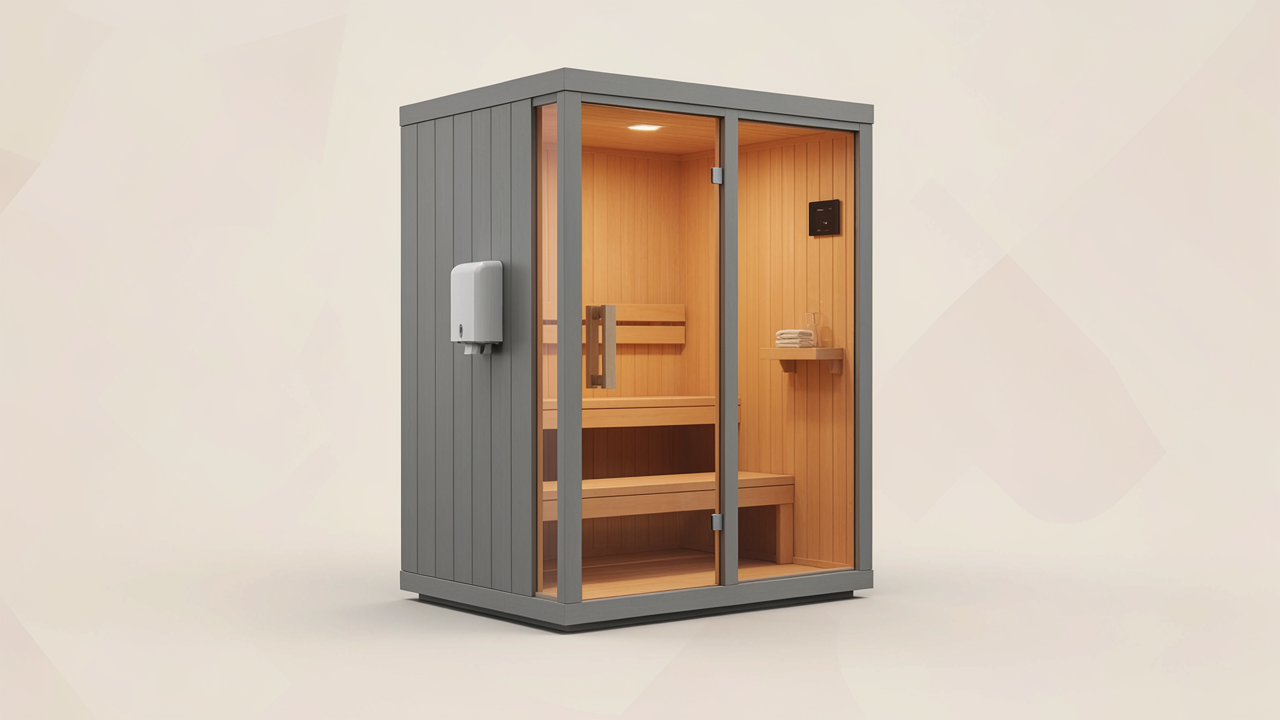
The first few minutes. The room starts warming through infrared panels built right into the walls, and somewhere in there a halogenerator kicks on, quietly releasing salt particles too small to see into the air. No steam, no visible mist, nothing hazy hanging around. The room just looks like a room.
The middle stretch. This is where you actually feel it. Body temperature climbs slowly as the infrared heat works its way a few centimeters into skin and muscle, rather than just heating up the air you’re sitting in. People who’ve always found regular saunas a bit much tend to handle this a lot better, since it doesn’t hit all at once. Salt particles keep drifting through the room the whole time, and you’re breathing them in without doing anything special, no technique to learn, nothing to remember.
The last stretch. A lot of sessions add chromotherapy toward the end, colored lighting set to specific wavelengths, sometimes paired with a light scent running through the room. Neither one is required. If you’d rather skip both, just ask, plenty of members do exactly that.
You keep your clothes on the whole time here, unlike a traditional dry sauna where people sometimes go minimal. Light, breathable stuff works best, since you will sweat, just noticeably less than you would in a standard high heat sauna.
That gap in air temperature explains a lot. Someone who taps out of a traditional sauna after four or five minutes can usually sit through a full HaloSauna session without much trouble at all.
This isn’t some trend somebody invented last year and slapped a wellness label on. Salt therapy traces back to salt mines in Eastern Europe, where people noticed something odd, miners came down with respiratory illness a lot less often than workers doing other kinds of labor. Nobody fully understood why at first. That observation eventually turned into speleotherapy, sitting inside actual salt caves as treatment, and later into the halogenerators spas use now, which basically recreate that environment mechanically.
Infrared heat has a totally separate backstory, built out of research into how different wavelengths of light interact with skin and tissue. Infrared saunas showed up commercially decades ago, marketed as a gentler alternative to standard heat therapy, mainly because people could sit through longer sessions without the temperature spiking uncomfortably.
Putting the two together is the newer part. You’ve got a therapy with centuries of informal use behind it sitting next to one studied closely in a more rigorous way only over the last few decades. That’s what HaloSauna actually is. Not one or the other. Both, at once.
The heat emitted by infrared bypasses the outer layer of your skin and penetrates further into the body instead of heating up the environment that you’re standing in. This helps you sweat at a relatively cooler ambient temperature compared to what a normal sauna would require to elicit similar results – and that’s precisely why the environment is warm instead of being stifling after 40 minutes.
On an average, the onset of sweating is observed around the 15 minute mark, building gradually as core temperature keeps climbing through the rest of the session. This slower buildup is easier on your cardiovascular system too, compared to the sudden spike a traditional sauna throws at you the moment you walk in.
There’s a practical upside to this pacing beyond just comfort. Because the heat comes on gradually instead of all at once, your body gets time to actually adjust as it goes. That is one of the main reasons why a person can endure a full 30-45 minutes of sweating in this sauna, instead of leaving after five minutes of sweating and dizziness in a regular sauna.
It raises your core temperature and gets you sweating, and sweating is part of how your skin supports the body’s normal detox process. It’s not doing the job your liver and kidneys handle, nothing replaces that, but the extra sweating is a genuine physical response, not just something written on a brochure to sound impressive.
A coastal lifestyle implies having to contend with constant humidity all year round, and thus, there are many more months when mold and dust triggers remain a problem compared to those who live in more arid conditions inland. Adding to this, one needs to consider a winter season when heat is running continuously in every home and office, thus creating dry indoor air. It is no wonder then that there are plenty of Hampton Roads citizens who suffer from at least some of the symptoms such as congestion, dry skin or general malaise.
That’s really the whole reason HaloSauna bookings climb so noticeably between late fall and early spring around here. Members dealing with dry, overheated indoor air during winter often find the humidity and warmth inside a session genuinely comfortable, in a way that might not land the same somewhere drier. Meanwhile the salt side does its own work on the congestion that hangs around this region longer than most. Booking sessions through those months, instead of waiting for things to get bad first, is the pattern most regulars settle into after a season or two.
The halotherapy part of a session runs through a device called a halogenerator, which grinds pharmaceutical grade salt down into particles small enough to disappear into the air of the sealed room. Small enough, actually, to travel deep into your respiratory tract when you breathe, which is the entire reason this exists.
Salt on its own has properties that make it genuinely useful for respiratory and skin support, not just in theory. Members dealing with seasonal allergies, mild congestion, or skin stuff like eczema or mild acne often ask specifically for halo salt therapy sessions during allergy season, or right after a cold when breathing just feels tight and off.
Worth clearing up, this isn’t table salt from somebody’s kitchen. It’s a specific pharmaceutical grade sodium chloride, processed and ground for halotherapy equipment on purpose, and that distinction matters for both safety and whether the treatment actually does anything.
Particle size ends up mattering more than most people would guess. Too large, and the particles just settle in your upper airway without ever reaching down into the lungs, which is where a lot of the respiratory benefit is thought to come from in the first place. A properly calibrated halogenerator, the kind you’d find in an actual spa rather than some novelty salt lamp on Amazon, produces particles fine enough to actually travel that far. The equipment quality behind a session matters just as much as the underlying idea does.
Yes, for most people. It’s pharmaceutical grade salt released at controlled, low concentrations designed specifically for inhalation. If you’ve got a severe respiratory condition, check with a doctor first just to be safe, but for general use this is considered safe and well tolerated.
This is one of the questions we get asked constantly, and there’s no single answer that fits everyone, but there is a reasonable starting point. First timers usually go once, see how their body reacts, and then figure out a rhythm from there based on what they’re actually trying to get out of it.
Members mostly after relaxation and stress relief tend to settle in once a week.Those who are utilizing it more specifically for skin problems or for their respiratory needs during allergy seasons or the driest part of the winters do increase the frequency to two or even three times a week. There is no exact limit to how often you may come, but typically people tend to come at such frequencies without making it seem like a burden for themselves.
It happens a lot that newly enrolled clients wonder whether frequenting will help to accelerate the effects. And the answer to this is always consistency over frequency in this case. Those who have been coming regularly once a week for two consecutive months have shown more effect than those who have been coming thrice in one week and missing out on it the next month.
A pretty wide mix of people end up trying halotherapy infrared sauna sessions, but a few groups show up again and again:
Members dealing with seasonal allergies or mild sinus congestion, especially heading into spring and fall around Hampton Roads
Athletes and regular gym-goers leaning on the infrared side specifically for muscle recovery after training
Members managing stress or just wanting a wind-down routine that doesn’t involve staring at a screen
Individuals with minor skin issues, eczema, mild acne, general dullness, people seeking a non-invasive procedure
Individuals who have used a regular sauna, found it to be too intense, and are seeking something similar yet more mild
None of this is a checklist you need to match. Plenty of members book a session purely because the combination of warmth, salt air, and quiet time appeals to them, full stop, no specific health goal attached at all.
The pollen counts at Hampton Roads tend to rise rapidly when early spring comes, and the humidity present in the region tends to prolong the life of mold and dust irritants well into the season compared to other areas where the climate is not so humid. Members dealing with the congestion caused by these irritants report feeling a difference in their breathing after the treatment sessions, particularly when multiple sessions are scheduled back-to-back within an allergy week.
Gym-goers and anyone dealing with regular soreness gravitate toward the infrared side of this specifically. Heat that actually gets below the skin loosens up tight muscles in a way a quick stretch on its own just doesn’t manage. Members tend to time sessions for a day or two after a hard workout rather than right before one, when the soreness has actually set in.
Salt carries natural antibacterial properties, and members dealing with mild acne or eczema sometimes notice their skin clarity improving after sticking with regular sessions over a few weeks. This won’t fix anything overnight, and it’s not meant to replace whatever a dermatologist has recommended for something more serious, but as a habit layered on top of a normal skincare routine, it’s a reason a lot of members keep coming back.
Not everyone books a session for physical reasons. Sometimes it’s just the warmth, the dim lighting, and having no phone in hand for 30 straight minutes, something a lot of people’s weeks genuinely don’t otherwise allow for. Adding chromotherapy or a guided meditation option tends to deepen that effect for anyone who’s really after a mental reset more than anything physical.
HaloSauna is gentler than a lot of heat therapy out there, but that doesn’t mean it’s zero risk across the board. Anyone dealing with a severe or unstable respiratory condition, uncontrolled high blood pressure, or who’s currently pregnant should run it by a doctor before booking. The effects of both heat and salt can be affected by some medical conditions in a manner that would not be applicable for a normal, healthy adult individual.
In case you suffer from claustrophobia, the enclosed room may feel a bit small at first. After only a minute or two, everyone feels comfortable when they realize that the door is not actually locked and that help will immediately come in case it is required. It is better to start with shorter sessions or leave the door unlocked in case it is possible. This is a reasonable way to ease into things rather than pushing through discomfort.
A handful of small habits genuinely change how a session feels and how long the benefits stick around. Drinking water before and after helps offset the sweating from the infrared portion, since walking dehydrated tends to make the second half feel more draining than it needs to. Showing up a few minutes early to actually settle in, rather than rushing over from a workout or a stressful commute, tends to make the relaxation part land better too.
Skipping heavy makeup or lotion beforehand lets your skin actually get some benefit from the salt exposure instead of it just sitting on top of a barrier layer. And if you’re trying infrared sauna sessions for the very first time, starting toward the shorter end of that 30 to 45 minute window is a reasonable way to gauge how your body handles it before committing to a longer sit.
Walking into Sundays for a first HaloSauna appointment doesn’t require any real prep beyond just showing up a few minutes early. Staff usually walk you through what’s coming before the session even starts, especially if you’ve never tried halotherapy or infrared heat before this.
- Check in at the front desk and change into light, breathable clothing if needed
- Staff briefly explains the room setup and answers any questions about session length or add-ons like chromotherapy
- The session starts with the halogenerator kicking on and the infrared panels gradually warming up
- Members typically sit or recline comfortably for the 30 to 45 minute session, with optional lighting and aromatherapy running throughout
- A staff member checks in partway through longer sessions, especially for first timers
- After the session, a few minutes to cool down and rehydrate before heading out
Most first timers walk out saying it was way less intense than they expected. That reaction comes up so often it’s basically the most common thing people mention afterward.
Members building out a fuller routine at Sundays often stack HaloSauna sessions with other services, either the same visit or spread across the week. The Cocoon Detox Pod and the PhysEdge FIT System, for instance, hit different angles of recovery and detox, and staff can help figure out a combination and pace that actually fits someone’s specific goals instead of treating HaloSauna as something you do in isolation.
For members focused mainly on skin, tanning services at the same locations sometimes get worked into a rotating schedule alongside HaloSauna, though the two aren’t really interchangeable, they’re doing different jobs.
HaloSauna sessions are available across Sundays locations in Hampton Roads, and booking works the same way it does for any other spa service here. If you’re thinking about adding regular sessions to your routine, ask staff how HaloSauna pairs with whatever else you’re already doing, since combining it with other treatments on the same visit is pretty common among members managing a fuller wellness routine.
Many new members have wondered whether they should call ahead of time or if just walking in will work. It all comes down to where they go and what time it is, and planning in advance is always safer, particularly if they are looking to book something during the evening or during winter. When the number of people wanting to use the facility rises along with the number of colds and flu. The staff can guide them to the best time to come in for their first session
Is HaloSauna good for individuals with respiratory diseases?
Yes, due to the use of pharmaceutical-grade salt in small amounts. However, those who suffer from serious respiratory problems are recommended to consult a physician.
What makes the HaloSauna different from a regular sauna?
The HaloSauna operates at a lower temperature, uses salt therapy provided by the halogenerator, and sessions take longer, up to 30 or 45 minutes compared to 15 or 20 minutes in case of saunas.